Discrimination, Sexual Harassment
Can I record workplace conversations? This guide explains audio recording consent law workplace rules, when recording harassment at work is legal, video recording at workplace rules, and how to preserve evidence. Learn state consent differences, admissibility of recordings in employment cases, best practices, and when to get HR or legal advice plus quick practical steps.
Estimated reading time: 18 minutes
Key Takeaways
Whether you can record workplace conversations depends on your state’s consent rule (one-party vs. all-party), federal law, and your employer’s policy.
Audio and video are treated differently: audio is governed by consent laws, while video raises separate privacy concerns and is often restricted in private areas.
In one-party states, you can usually record if you are a participant; in all-party states, secret recording can be illegal and risky.
Recordings are more likely to be admitted if legally obtained, preserved without edits, and supported by an evidence log, witness statements, and other corroboration.
Before recording or sharing evidence, review company policy and get legal or HR guidance to protect yourself from discipline or legal exposure.
Table of Contents
At a Glance: Quick Answers
Legal Framework: How Audio Recording Consent Laws Work
Audio vs. Video Recording: Different Rules and Privacy Expectations
Recording Harassment at Work: Legality and Practical Best Practices
Admissibility of Recordings in Employment Cases
How to Preserve Evidence of Harassment Beyond Recordings
What to Do After You Record or Collect Evidence
Practical Dos and Don’ts
Real-World Examples and Short Illustrative Scenarios
Summary and Key Takeaways
Conclusion
FAQ
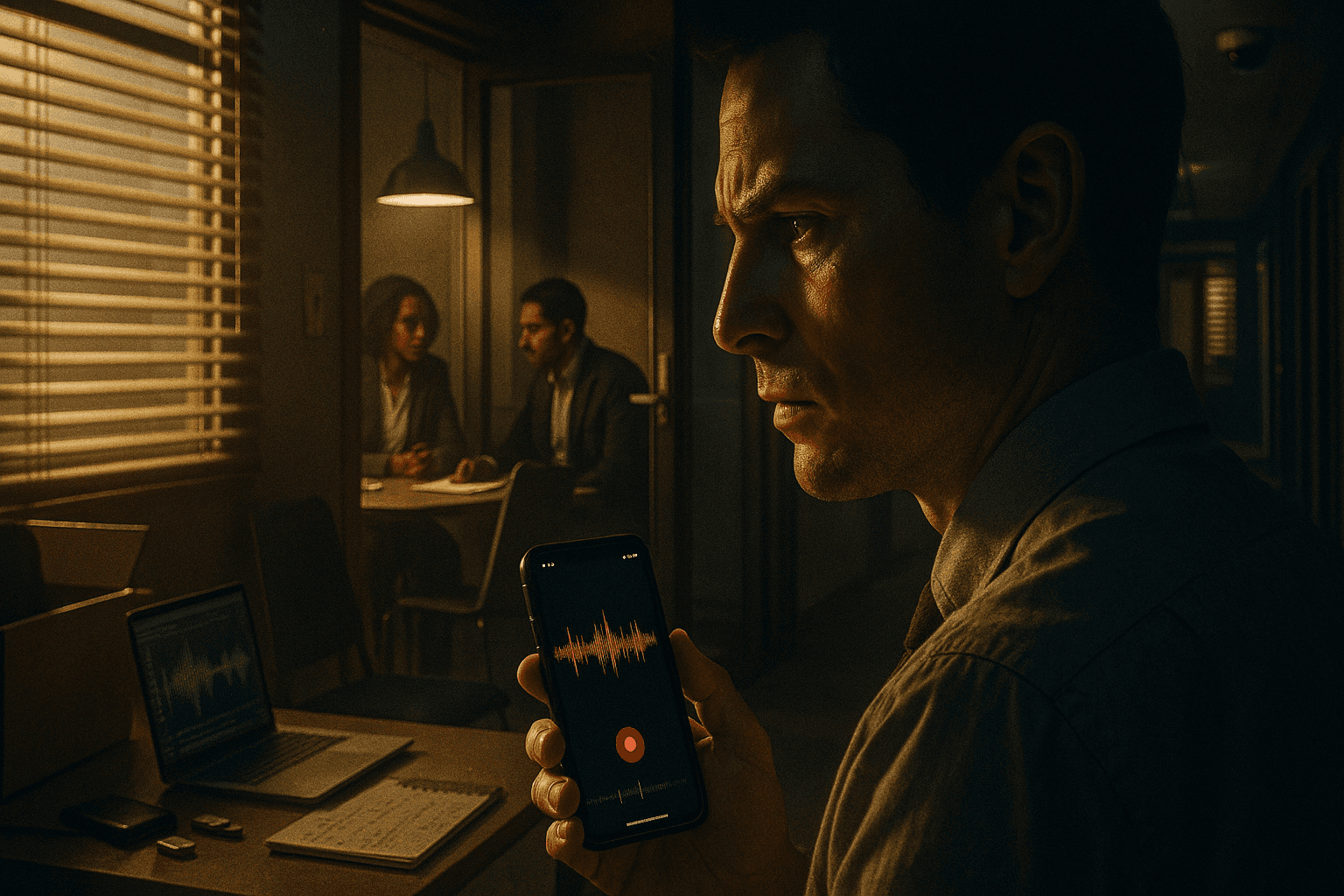
Can I record workplace conversations? Many employees ask this when they want to preserve evidence of harassment, discrimination, or unfair treatment. Workers consider recording to document discriminatory remarks, capture hostile interactions, protect against false accusations, and provide contemporaneous proof for HR or a court.
This guide explains, in plain English, the audio recording consent law workplace rules that control whether and how you can record. We map state consent rules, federal overlays, company policy considerations, video vs. audio differences, admissibility criteria, and practical preservation steps so you can make informed choices with lower legal risk.
Your rights depend on state consent laws, federal legislation, and company policy. Several authoritative sources outline these overlapping rules and risks, including a practical overview of one-party and two-party consent rules from J. J. Keller’s discussion of recording conversations at work, a legal analysis of risks from RPJ Law’s exploration of pressing record at work, and employer- and employee-focused guidance from Seyfarth’s overview of workplace recordings and eavesdropping risks.
At a Glance: Quick Answers
Likely legal: In a one-party consent state, if you are a participant in the conversation, audio recording is often lawful. Always verify state law and policy first. This directly addresses, “can I record workplace conversations?”
Risky or illegal: In all-party consent states, secret audio recording of a private conversation without every participant’s consent can be criminal and create civil liability. Recording in private areas or where privacy is expected is high risk under video recording at workplace rules.
Check policy: Even if lawful under state law, your employer may ban recordings. Violating policy can lead to discipline or termination.
When to seek guidance: Before recording, or before sharing a recording, consult HR or an employment attorney—especially if you need to assess admissibility of recordings in an employment case or to follow the audio recording consent law workplace correctly.
Legal Framework: How Audio Recording Consent Laws Work
One-Party vs. All-Party Consent: Basics
One-party consent means only one participant in the conversation needs to consent to the recording. If you are a participant, you are typically the “one party,” and you can record without telling others in most states. Trusted overviews of this rule appear in J. J. Keller’s article on recording in the workplace, RPJ Law’s analysis, and Seyfarth’s guidance.
Two-party (all-party) consent means every participant must consent before you record. Secret recording without everyone’s consent can violate criminal laws and lead to civil liability. Commonly cited all-party consent states include California, Florida, Illinois, Maryland, Massachusetts, Michigan, Montana, New Hampshire, Pennsylvania, and Washington, as summarized by J. J. Keller.
Practical Consequences of Violations
Criminal exposure: All-party states can impose criminal penalties for secret recording.
Civil liability: People recorded without consent may sue under wiretapping or privacy statutes.
Employment discipline: Even if a recording is legal under state law, an employer may discipline you for violating company policy or confidentiality rules, as detailed in Seyfarth’s overview of workplace recording risks.
Exclusion of evidence: Illegally obtained recordings may be excluded in court or in an agency proceeding.
Federal Overlay: ECPA and the Federal Wiretap Act
Federal statutes, including the Electronic Communications Privacy Act (ECPA) and the Federal Wiretap Act, can apply to certain intercepted communications, interstate calls, or electronic messages. Their application depends on the medium (e.g., phone call vs. in‑person conversation), how the recording occurs, and the facts of the case. See RPJ Law’s discussion of federal overlay and risk and Seyfarth’s employer-focused analysis.
Employer Policies vs. Law
Even when a state’s one-party rule would allow recording, your employer may lawfully adopt stricter no-recording policies for the workplace. Violating those policies can lead to discipline, termination, or other consequences—even where criminal law is not violated. See Seyfarth’s guidance on policy limits and liability.
Quick Compare: Consent Rules, Risks, and Examples
One-party consent
Rule: Only one participant needs to consent.
Risk level: Lower, if you are a participant and policy allows.
Example: You record a meeting you attend to capture discriminatory remarks for a future HR complaint.
All-party consent
Rule: Every participant must consent.
Risk level: Higher; secret recording may be criminal and create civil liability.
Example: You secretly record a private sit-down in Massachusetts without consent; this can lead to criminal charges and the recording may be unusable.
Employment policy overlay
Rule: Employers can ban recordings or require advance approval.
Risk level: Policy violations can lead to discipline even if the recording is legal under state law.
Example: Your handbook prohibits recording; you record anyway. HR disciplines you for policy violations.
If you are already facing a hostile work environment, review what legally qualifies as “hostile” and what to document in our hostile work environment guide and get broader context on workplace sexual harassment rights and remedies.
Audio vs. Video Recording: Different Rules and Privacy Expectations
Clear Definitions
Audio-only recordings capture sound—typically governed by state consent statutes (one-party or all-party). Video recordings capture images and sometimes sound; video triggers separate privacy issues and often stricter employer restrictions.
Areas with Heightened Privacy Expectations
Recording in places where people expect privacy—like restrooms, locker rooms, or private offices—raises serious legal and policy concerns. Many states and employers prohibit cameras in those areas outright. If video includes audio in an all-party state, the audio layer adds another consent requirement. See Seyfarth’s analysis regarding heightened privacy and recording risks.
Practical Scenarios
One-on-one meeting at your desk (audio-only)
One-party state: If you are a participant and policy permits, recording may be lawful.
All-party state: Secret recording is typically unlawful; seek consent or rely on note-taking.
Videoing a coworker in a private office without consent
High risk of violating privacy expectations and policy; may be unlawful depending on state law.
Filming a group in a common area without a reasonable expectation of privacy
Lower privacy expectation, but policies often still prohibit unsanctioned recording; check your handbook.
Because surveillance and monitoring rules vary, refresh your understanding of workplace privacy rights and employer monitoring policies before you hit “record.”
Recording Harassment at Work: Legality and Practical Best Practices
Direct Legal Answer by State-Type
If you are in a one-party consent state and are part of the conversation, recording alleged harassment is often lawful. This general rule is summarized in J. J. Keller’s workplace recording overview, RPJ Law’s analysis of recording risks, and Seyfarth’s discussion.
If you are in an all-party consent state, covertly recording a private conversation without every participant’s consent is generally illegal—even if your goal is to document abuse. Both RPJ Law and Seyfarth caution that secret recording can create criminal and civil liability and may render the recording unusable.
NLRA Concerted Activity: A Narrow, Fact-Specific Protection
The National Labor Relations Act (NLRA) protects certain “concerted activities” by employees, including collective efforts to improve working conditions. In limited circumstances, if recording is part of a group effort to document and address workplace issues (for example, systemic harassment affecting multiple employees), the NLRA may provide protection. However, this is narrow, highly fact-dependent, and not a blanket shield against state recording laws or employer policies. See Seyfarth’s explanation of NLRA issues in recording.
Best-Practice Checklist
Before recording: Confirm your state’s consent rule and read your employer’s handbook and agreements; if unsure, ask HR or consult an employment attorney.
Favor transparency when safe: Consider asking for permission to record; secure explicit consent before you press record in all-party states.
Limit scope: Record only interactions you participate in; avoid capturing third-party private conversations.
Respect private spaces: Do not record in restrooms, locker rooms, or places with heightened privacy expectations.
Document context immediately: Note date, time, location, participants, and a short description of what happened and why you recorded.
Secure the original file: Do not edit or alter; back up promptly and keep your device safe.
Seek guidance before sharing: Legal or HR advice can prevent accidental policy violations or waiver of rights.
If permission to record is refused, continue documenting. Take detailed contemporaneous notes, keep relevant emails and messages, and, when safe, ask witnesses to write what they observed. For broader guidance on documenting a hostile environment and harassment, see our resources on reporting a hostile work environment and getting legal support for workplace harassment.
Admissibility of Recordings in Employment Cases
Admissibility vs. Weight
Admissibility means whether a judge, jury, arbitrator, or agency will allow the recording into evidence. Weight means how persuasive that recording will be once admitted. A lawful, clear recording that is well-preserved and corroborated is far more likely to help your case than a shaky, edited clip of uncertain origin.
Primary Factors Courts Consider
Legality of the recording: Evidence obtained illegally is likely excluded and can expose the recorder to liability. See Seyfarth’s analysis of legal risks and exclusions.
Expectation of privacy: Recordings of locations with clear privacy expectations (restrooms, locker rooms, private offices) are more likely to be excluded.
Authenticity and integrity: Courts need assurance the recording is genuine and unaltered.
Chain of custody: Who recorded it, who had access, and how it was transferred or backed up.
Context and corroboration: Supplemental evidence—emails, calendar invites, chat logs, witness statements—strengthens the narrative.
Technical Steps to Preserve Evidentiary Value
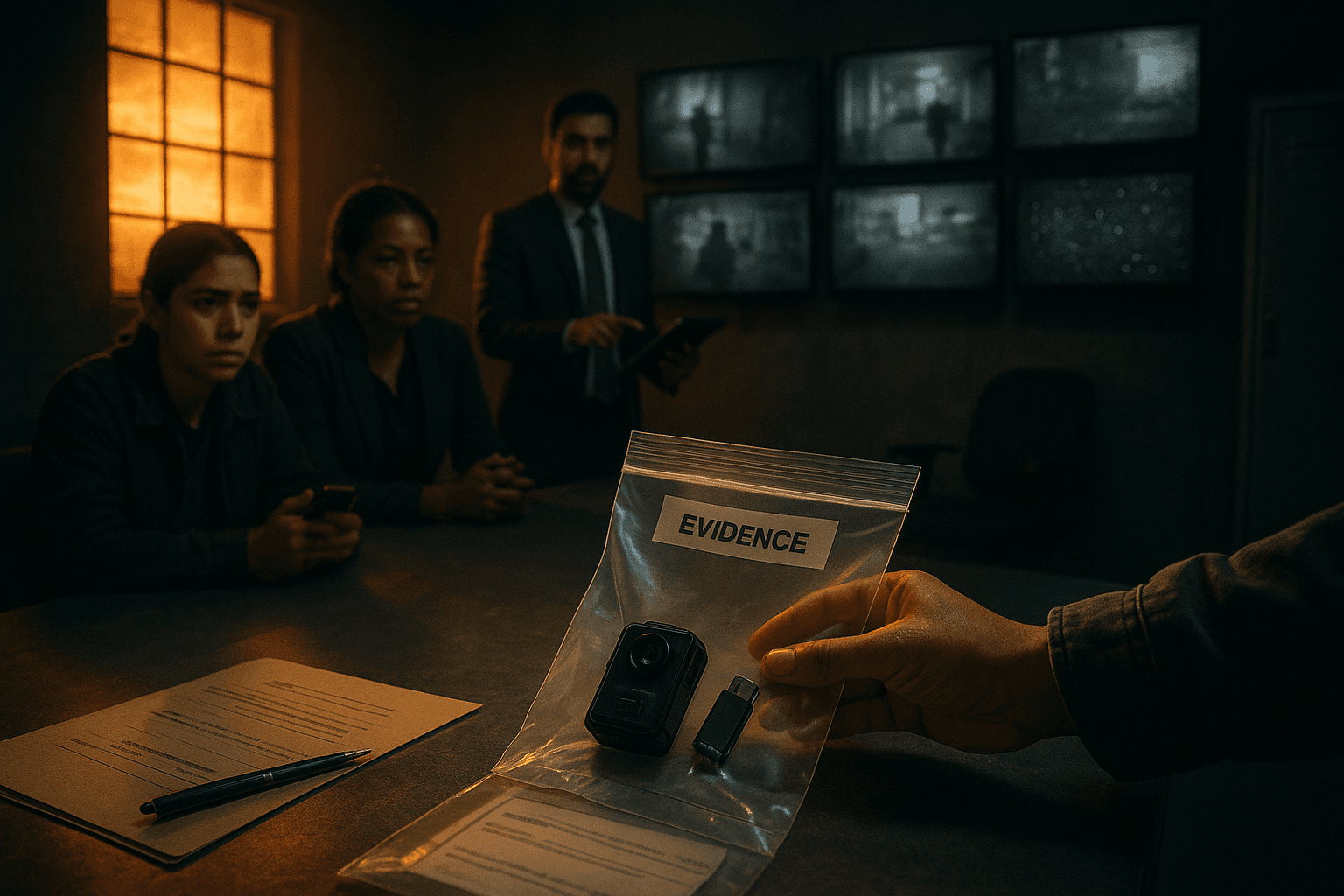
Keep the original device and file: Do not edit, trim, or overwrite the original.
Export immediately to a secure location: Use encrypted cloud storage or an external drive; make at least one exact copy.
Compute file hashes: Record MD5 or SHA256 hashes for the original and any forensic copies. Store these values in your evidence notes.
Capture metadata: Date and time created, device and app used, file size, and where applicable, GPS/location metadata (mind privacy implications).
Document chain of custody: Note every person who accessed the file, the date/time of transfer, and the reason for access.
If redaction is necessary: Preserve the untouched original and separately document any edits to subsequent versions.
Corroborate: Gather contemporaneous notes and witness statements to contextualize what the recording shows.
Seek advice before submission: Consult HR or an attorney before sending a recording to your employer, an agency, or a court. See RPJ Law’s discussion of admissibility and risk and Seyfarth’s guidance.
Evidence Log: Fields to Capture
To maximize the admissibility of recordings in an employment case, track at least these fields in your notes:
Item ID; Type (audio/video)
Original file name; Date/time recorded; Location
Participants; Recorder name
Device used; App used (if applicable)
Exported file name(s); Export date/time
Hash value(s) (MD5, SHA256) for original and copies
Storage location(s)
Access log (names, dates, purpose)
Notes/corresponding documents (emails, chat logs, witness statements)
For more on building a strong harassment record that complements any recordings, see our step-by-step guides on reporting workplace discrimination and filing a complaint with the EEOC.
How to Preserve Evidence of Harassment Beyond Recordings
Recordings can be powerful, but they are rarely enough alone. Corroboration strengthens credibility, fills gaps, and reduces reliance on a single piece of evidence.
Contemporaneous notes: Keep a dated log with time, place, who was present, exact words or actions, your reaction, and any follow-up.
Save communications: Preserve emails, texts, Slack/Teams chats, voicemails, memos, calendar invites. Export copies (e.g., to PDF/PNG) to capture timestamps and layout.
Witness statements: Ask coworkers who observed the incident to write a short, dated statement (name, title, contact, date/time observed, specific words/actions).
Electronic logs: If harassment is ongoing, legal counsel can help request a preservation hold for relevant accounts or servers.
Physical evidence: Photograph notes or items left on your desk with timestamps; retain originals if safe to do so.
HR records: Keep copies of complaints and responses; log meeting dates and participants.
Retaliation tracking: If adverse actions occur after you complain, log timing and details to help show causation.
Do not access private accounts, break passwords, or impersonate others to obtain evidence. Those actions can create legal exposure. For context on multi-pronged evidence strategies and legal boundaries, review Seyfarth’s guidance on managing legal liability when gathering proof and our overview of workplace harassment legal options for employees.
What to Do After You Record or Collect Evidence
Secure the evidence: Follow the preservation steps above—no edits, immediate export, hashes, and a chain-of-custody record.
Consider an internal report: A written complaint to HR should summarize incidents with dates, participants, and a brief description. List the evidence you have (for example, notes, emails, recordings) and the remedies you seek.
Escalate if necessary: If the employer ignores your complaint or retaliates, consider filing with your state fair employment agency or the EEOC. Deadlines are short. Our guides on reporting discrimination and EEOC complaint filing explain timelines and steps.
Consult counsel: Bring your evidence list, originals, and your preservation notes. This helps an attorney quickly assess the admissibility of recordings in an employment case and the strength of your overall proof. See also RPJ Law’s risks overview and Seyfarth’s recommendations.
If you are documenting harassment or an increasingly toxic environment, our plain-English explainer on what qualifies as a hostile work environment can help you decide what to capture and how to describe it in factual terms.
Practical Dos and Don’ts
Dos
Do check your state consent rule and your employer’s policy before recording.
Do document context immediately after any incident.
Do preserve originals, make exact copies, and log file hashes and chain of custody.
Do seek consent where practical and safe, especially in all-party consent states.
Do consult HR or an employment attorney before widely sharing any recording.
Don’ts
Don’t record in areas with clear privacy expectations (restrooms, locker rooms, private offices).
Don’t edit, trim, overdub, or enhance the original file.
Don’t access coworkers’ private accounts or impersonate anyone to get evidence.
Don’t rely solely on recordings—collect emails, messages, notes, and witness statements to preserve evidence of harassment.
For a deeper dive into harassment definitions and examples, see our primer on understanding workplace sexual harassment.
Real-World Examples and Short Illustrative Scenarios
Vignette A: One-Party State
During a team meeting, a supervisor makes a bullying remark about your protected characteristic. You are a participant and your state follows one-party consent. You record the meeting, preserve the original, compute a hash, and log date/time, device, and participants. You also save corroborating emails and ask a coworker to write what they heard. You submit an internal complaint supported by the recording and documentation. HR investigates and takes corrective action.
What helped: Lawful recording, chain of custody, corroboration, and timely HR report. This aligns with video and audio recording at workplace rules that prioritize consent and careful preservation.
Vignette B: Two-Party (All-Party) State
You secretly record a private, closed-door meeting with your manager without asking for consent. Your state requires all parties to consent. When the dispute escalates, the employer discovers the recording and disciplines you for policy violations. In later litigation, the recording is excluded, and you face separate risk for the unlawful recording itself.
What went wrong: Covert recording in an all-party state, policy violation, and potential statutory liability. Both RPJ Law and Seyfarth warn about these outcomes.
Vignette C: Video in a Private Area
Convinced that a coworker is spreading lies, you place a hidden camera in a private office to capture a confrontation. The video also records audio. The location carries a reasonable expectation of privacy, and your state is all-party. The employer terminates you for violating policy and privacy rules, and legal exposure follows.
What went wrong: Video in a private location, expectation of privacy, and audio capture without consent in an all-party state. The result is high legal and employment risk, consistent with Seyfarth’s privacy and monitoring guidance.
Need help documenting or reporting issues without violating policy? Our resources on effective reporting steps and harassment legal support options can help you proceed carefully.
Summary and Key Takeaways
You may be able to record workplace conversations if you are a participant in a one-party consent state, but laws vary widely and employer policy still matters.
Video recordings and recordings made in areas with a reasonable expectation of privacy carry added legal risk; always check video recording at workplace rules and your handbook.
The admissibility of recordings in an employment case improves when the capture was lawful, the file is preserved without edits, and corroboration (notes, emails, witnesses) is strong.
When in doubt, consult HR or an employment attorney before recording or submitting recordings as evidence to preserve evidence of harassment without creating new risk.
Conclusion
Recording can protect you—but only if you follow the law, honor company policy, respect privacy, and preserve files properly. If you are navigating harassment, discrimination, or retaliation, take time to learn your state’s consent rule, decide whether audio or video is appropriate, and gather corroboration to strengthen your position. It is common to feel unsure about what is legal and what will be admissible; a short conversation with HR or an employment attorney can help you proceed safely and effectively.
Need help now? Get a free and instant case evaluation by US Employment Lawyers. See if your case qualifies within 30-seconds at https://usemploymentlawyers.com.
FAQ
If I’m in a one-party consent state, can I post the recording on social media?
It’s risky. Even if recording was lawful, employer policies and privacy laws may restrict sharing. Posting publicly can worsen workplace consequences and complicate litigation strategy. See Seyfarth’s guidance on limiting legal liabilities from workplace recordings.
Can my employer discipline me if I legally record a conversation?
Yes. Policies can prohibit recording regardless of state law. Employers may discipline for policy violations or confidentiality breaches even if the recording itself was lawful. See Seyfarth’s analysis of employer policy and legal exposure.
Will a secretly recorded video be admissible in court?
Maybe not. Admissibility turns on legality, privacy expectations, and preservation. Illegally obtained recordings are often excluded and may create liability. Review RPJ Law’s overview of risks and admissibility concerns for details.
How can I prove harassment if I can’t record?
Build a comprehensive record: contemporaneous notes, emails, chat logs, calendar entries, and dated witness statements. Preserve HR complaints and responses. Our resources on understanding workplace sexual harassment and reporting discrimination explain what to save and how to present it.
Should I choose audio or video if I decide to record?
Audio is controlled by consent statutes; video raises separate privacy issues and is often riskier, especially in private areas. In all-party states, combining video with audio typically requires consent from everyone recorded. See Seyfarth’s privacy and recording rules discussion.
This post provides general information and does not constitute legal advice. Laws vary by state and fact pattern. Consult an employment attorney or your HR/legal department about your specific situation before recording or using recordings as evidence.